
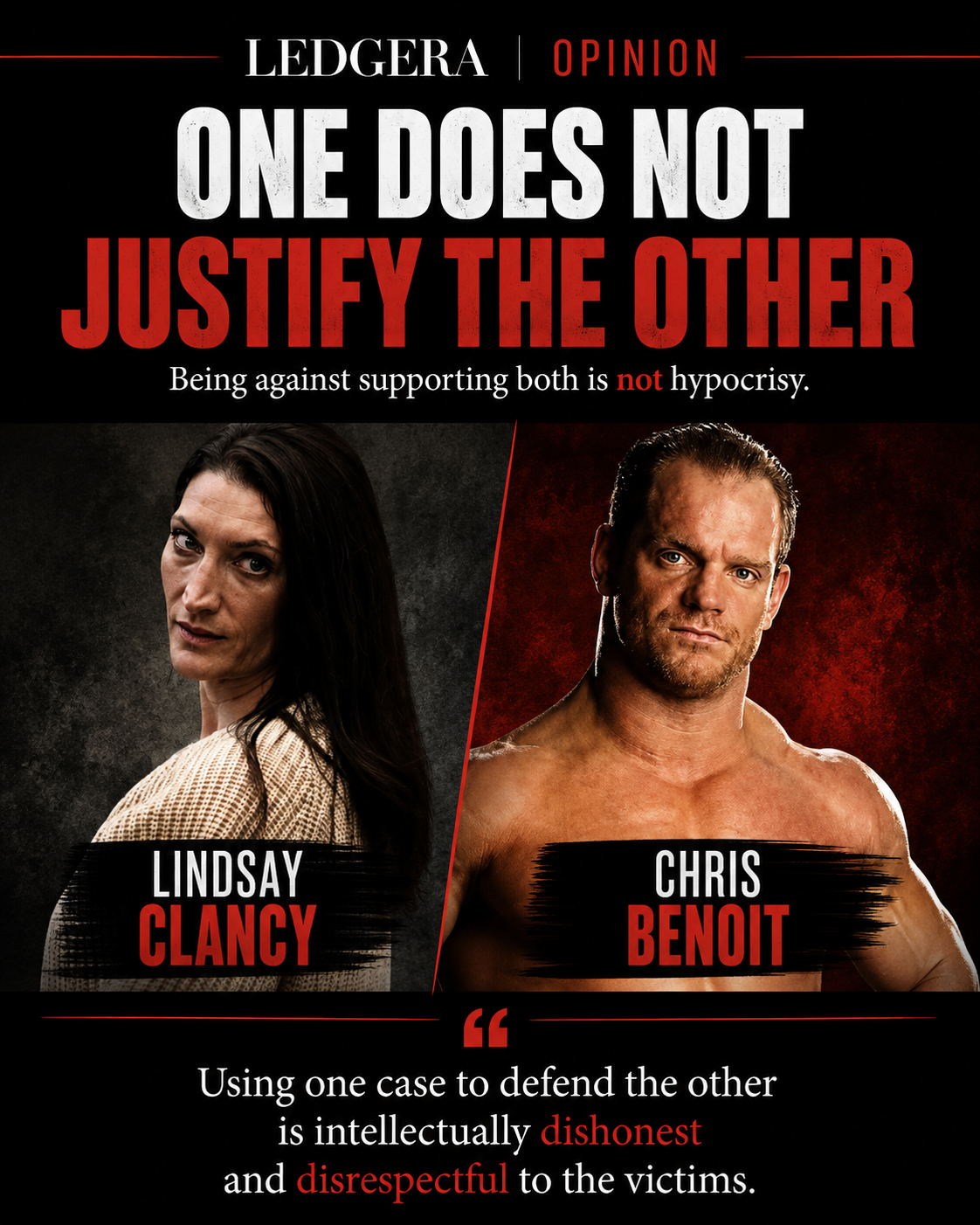
There is a particular kind of argument that only seems intelligent when it is compressed into an Instagram graphic.
"If you can support Lindsay Clancy, then I can support Chris Benoit."
No.
That is not a moral argument.
That is not consistency.
That is not nuance.
And it certainly is not logic.
It is an attempt to take one horrific situation, strip it of every complicated fact surrounding it, place it beside another horrific situation, and declare that the existence of perceived sympathy for one person somehow creates a permission slip to sympathize with another.
It does not.
You do not earn the right to rehabilitate Chris Benoit because somebody somewhere has sympathy for Lindsay Clancy.
You do not make Lindsay Clancy's case less disturbing by pointing at Chris Benoit.
You do not make Chris Benoit's actions less horrifying by pointing at Lindsay Clancy.
And the victims in either case should never become ammunition in an online argument about whose favorite accused or confirmed killer deserves more grace.
That is the first thing we need to understand.
Two horrors do not cancel each other out.
The internet has become frighteningly comfortable treating human tragedy like fandom discourse.
Pick a side.
Choose a villain.
Choose somebody to defend.
Find the hypocrisy in the opposing camp.
Make a meme.
Post a comparison.
Win the argument.
Except these are not fictional characters.
Nancy Benoit was a real woman.
Daniel Benoit was a real seven-year-old boy.
Cora Clancy was five.
Dawson Clancy was three.
Callan Clancy was eight months old.
Those names should immediately make this conversation feel different.
Because once the victims become real people instead of background details, the entire "if you support her, I support him" argument begins to look exactly as grotesque as it is.
Chris Benoit Does Not Need a Redemption Campaign
Chris Benoit was an extraordinary professional wrestler.
That sentence is true.
Chris Benoit also killed his wife and son before killing himself.
That sentence is more important.
Both can exist simultaneously.
This is where wrestling culture has struggled for nearly two decades.
Fans remember the matches.
The intensity.
The technical ability.
The WrestleMania XX celebration.
The diving headbutt.
The championship victories.
The entrance music.
The years of performances that became embedded in wrestling history.
And because people formed emotional relationships with that performer before June 2007, some have spent years searching for a way to separate the wrestler they admired from what happened inside his home.
There is a human impulse behind that.
People do not enjoy discovering that someone they admired committed something monstrous.
It produces cognitive dissonance.
Your memories tell you one thing.
Reality tells you another.
But discomfort is not injustice.
Sometimes there is no satisfying reconciliation.
Sometimes the adult response is simply:
I once admired this person. Then I learned something that permanently changed how I see him.
That is allowed.
You do not need a loophole.
You do not need another murderer to point toward.
You do not need to transform documented brain trauma into a posthumous acquittal.
You do not need to pretend that appreciating the historical significance of his wrestling career requires defending the person responsible for Nancy and Daniel's deaths.
His medical history matters.
His neurological condition matters.
Repeated head trauma matters.
CTE research matters.
Steroid and prescription-drug questions matter.
The brutal working conditions of professional wrestling during that era matter.
All of those things deserve examination.
But there is an enormous difference between explanation and exoneration.
Understanding what may have happened inside someone's brain is not the same as declaring that the resulting actions no longer matter.
Context is not absolution.
Science is not absolution.
Mental illness is not automatically absolution.
Brain injury is not automatically absolution.
Addiction is not automatically absolution.
Trauma is not automatically absolution.
Those factors can radically alter how we understand behavior. They may even alter legal responsibility in cases where a court is able to examine them.
But they do not resurrect victims.
And they do not require society to transform the person responsible into a misunderstood hero.
Chris Benoit does not need to be inducted into a Hall of Fame to acknowledge that he was talented.
He does not need celebratory merchandise.
He does not need nostalgic edits that quietly delete the final chapter of his life.
And he certainly does not need Lindsay Clancy's dead children recruited as evidence for why wrestling fans should feel comfortable "supporting" him again.
And Lindsay Clancy Should Not Become a Mascot Either
The same principle applies in the other direction.
There is an important distinction that gets destroyed by social media language.
What does someone mean when they say they "support Lindsay Clancy"?
Do they support awareness of postpartum psychosis?
Do they believe women experiencing severe postpartum psychiatric symptoms deserve earlier intervention?
Do they believe the healthcare system failed to recognize warning signs?
Do they believe a defendant has a right to present an insanity defense?
Do they believe criminal responsibility can be affected by psychosis?
Do they believe she should receive psychiatric treatment rather than punishment if a jury finds she lacked criminal responsibility?
Those are legitimate questions.
Or do they mean:
She should be celebrated.
She should be treated as though nothing happened.
The children should become secondary characters in a story centered entirely around sympathy for their mother.
Those are very different positions.
As this is being written, Lindsay Clancy's trial is forcing a jury to confront exactly the distinction that social media refuses to make.
Her defense argues that severe mental illness, including postpartum psychosis, deprived her of criminal responsibility.
Prosecutors argue that she understood her actions and acted deliberately.
That is what trials are for.
Evidence.
Experts.
Cross-examination.
Standards of law.
A jury.
Not Instagram slides.
Not wrestling memes.
Not "well if you support her…"
And it is possible to believe postpartum psychosis is real, dangerous and criminally relevant without minimizing the deaths of three children.
It is possible to believe women suffering severe postpartum psychiatric crises need dramatically better medical intervention while still saying that Cora, Dawson and Callan must remain at the center of the story.
It is possible to have compassion without constructing a saint.
It is possible to demand accountability without pretending psychiatric illness does not exist.
Human beings should be capable of holding more than one thought at a time.
Mental Illness Is Not a Team Sport
One of the ugliest consequences of these debates is what they do to conversations about mental illness.
People invoke mental illness only when it benefits the person they already want to defend.
When they like the defendant:
"Have compassion."
"Look at the diagnosis."
"They weren't themselves."
"The system failed them."
When they dislike the defendant:
"Monster."
"Evil."
"Throw away the key."
That is not serious thinking.
If mental illness matters, then it matters even when the defendant is someone you dislike.
If brain injury matters, then it matters even when understanding it makes you uncomfortable.
If accountability matters, then it matters even when the perpetrator was once your childhood hero.
The principles have to survive contact with people you do not like.
Otherwise they are not principles.
They are fandom.
And this is precisely why comparing Clancy and Benoit as though one case creates permission to excuse the other is so intellectually bankrupt.
Even if two people suffered serious neurological or psychiatric conditions, that does not automatically mean their conditions were identical.
It does not mean their awareness was identical.
It does not mean their capacity for control was identical.
It does not mean the sequence of events was identical.
It does not mean the medical evidence was identical.
It does not mean the law would treat them identically.
And it absolutely does not mean morality requires the public to either support both or condemn both in exactly the same language.
Two cases can contain superficial similarities and still be profoundly different cases.
That is why courts examine individuals.
That is why medicine diagnoses individuals.
That is why circumstances matter.
"If X, therefore Y" sounds clean.
Reality rarely is.
Explanation Is Not Excuse
This distinction needs to become part of our cultural vocabulary.
To explain something is to ask:
How did this happen?
To excuse something is to say:
It should not meaningfully count against the person who did it.
Those are not synonymous.
We should want explanations.
In fact, society desperately needs them.
If postpartum psychosis contributed to a catastrophe, understanding it may help another family recognize symptoms before another tragedy occurs.
If repeated traumatic brain injuries contributed to catastrophic behavioral changes in an athlete, understanding that matters for every athlete who comes afterward.
If medication interactions contributed to psychiatric deterioration, study them.
If an industry exposed performers to unacceptable neurological risk, investigate it.
If clinicians missed warning signs, examine why.
Understanding causes is how prevention happens.
But prevention does not require pretending consequences never occurred.
You can study the bridge collapse while still mourning the people who fell.
You can investigate the fire while still naming who died.
And you can investigate the mind of someone who committed an atrocity without turning the investigation into fandom for the perpetrator.
Stop Making the Victims Supporting Characters
Perhaps the greatest moral failure surrounding the Benoit discourse is how frequently Nancy and Daniel disappear from it.
People ask:
Should Benoit enter the WWE Hall of Fame?
Should WWE acknowledge his matches?
Can fans wear his merchandise?
Can we separate art from artist?
Was it CTE?
Was it steroids?
Would Benoit have done it with a healthy brain?
All interesting questions.
But notice who slowly disappears.
Nancy.
Daniel.
The conversation becomes almost entirely about Chris.
His career.
His brain.
His legacy.
His reputation.
His accomplishments.
His tragedy.
His possible redemption.
Nancy becomes "his wife."
Daniel becomes "his son."
Their identities orbit his.
Even in death.
That should bother us.
And the same danger exists in the Clancy case.
If the entire cultural conversation becomes exclusively about postpartum psychosis, criminal responsibility, medication, motherhood and sympathy for Lindsay Clancy, then three children risk becoming symbols rather than people.
Cora.
Dawson.
Callan.
Five.
Three.
Eight months.
Any discussion of compassion that requires forgetting them is incomplete.
Any discussion of Chris Benoit's legacy that requires mentally removing Nancy and Daniel from the picture is morally hollow.
The dead should not have to disappear for us to feel empathy for the living.
Compassion Is Not Endorsement
We also need to rescue the word compassion from this debate.
Compassion does not mean applause.
Compassion does not mean fandom.
Compassion does not mean innocence.
Compassion does not mean putting someone's face on a T-shirt.
Compassion means recognizing another human being's suffering without lying about the suffering they caused.
That distinction matters enormously.
Someone can believe Lindsay Clancy was profoundly psychiatrically ill and still grieve the children.
Someone can believe Chris Benoit suffered devastating neurological damage and still refuse to celebrate him.
Someone can acknowledge that perpetrators can also be damaged human beings.
That does not erase victims.
In fact, mature compassion requires refusing simplistic narratives altogether.
The world would be easier if every person who did something horrifying were a cartoon villain who woke up perfectly healthy and simply chose evil.
Sometimes that happens.
Sometimes circumstances are dramatically more complicated.
But complexity does not magically produce innocence.
And acknowledging complexity does not require moral surrender.
There Is No Moral Coupon System
The comparison being circulated essentially argues:
If society gave Person A compassion, I have acquired one coupon redeemable for compassion toward Person B.
That is absurd.
Morality does not operate through trade.
Someone else's hypocrisy does not determine your ethics.
Even if every single person defending Lindsay Clancy were behaving hypocritically—and they are not all expressing the same position—that would tell us absolutely nothing about whether supporting Chris Benoit is morally justified.
Nothing.
Imagine saying:
"You excused that drunk driver, therefore I am entitled to excuse this drunk driver."
No.
The first decision being wrong would not make the second one correct.
Two wrong moral judgments do not combine into consistency.
They produce two wrong moral judgments.
If you believe people are incorrectly excusing Lindsay Clancy, argue that.
Make the argument.
Discuss the evidence.
Discuss criminal responsibility.
Discuss where you believe compassion ends and accountability begins.
But dragging Chris Benoit into it does not strengthen that case.
It reveals that the actual objective was never consistency.
It was permission.
Permission to say:
"You defend yours, so I get to defend mine."
That is fandom logic.
Not moral logic.
Chris Benoit Was Not a Wrestling Character When This Happened
Another problem unique to Benoit's case is that decades of professional wrestling blur fiction and reality.
Wrestling teaches audiences to redeem villains.
A heel becomes a babyface.
A betrayal becomes a storyline.
A hated character returns years later to applause.
Real life does not have that booking structure.
There is no redemption arc automatically scheduled because enough time passed.
There is no surprise return.
There is no entrance music capable of turning June 2007 into ancient wrestling lore.
The final events of Chris Benoit's life were not part of a storyline.
Nancy was not performing.
Daniel was not performing.
There was no referee.
There was no script.
There was no Monday-night reset.
The wrestling industry continued.
Their lives did not.
That is why attempts to discuss Benoit's "legacy" exclusively through wrestling achievements feel so wrong.
His professional career is historical fact.
So is what happened afterward.
History does not require us to erase either one.
But celebration is different from documentation.
A wrestling historian can discuss his matches.
A documentary can examine his career.
Researchers can study his brain.
Journalists can investigate the culture in which he worked.
That is historical examination.
Putting him on a pedestal is something else.
The CTE Conversation Deserves Better Than This
Reducing the Benoit tragedy to "he had CTE, therefore he cannot be blamed" actually does a disservice to brain-injury advocacy.
Millions of people experience concussions and neurological disorders without murdering their families.
That does not mean Benoit's brain damage was irrelevant.
It means human behavior cannot be reduced to one neurological scan and a slogan.
Serious science asks difficult questions.
What behaviors can traumatic brain injury influence?
How much can impulse control change?
Can aggression increase?
How does depression interact with neurological damage?
What other substances or psychiatric factors were present?
What can doctors confidently conclude?
What remains unknowable?
Those are serious questions.
"He had brain damage so everything is forgiven" is not serious science.
Likewise:
"Postpartum psychosis is real so no mother experiencing it can ever be held responsible for anything" would not be serious psychiatry.
Medicine provides evidence.
Courts determine legal responsibility.
Society still has to wrestle with moral meaning.
Those are related conversations.
They are not identical ones.
We Need Better Language Than "Support"
Maybe part of the problem is the word itself.
"Support."
It is so vague that two people can say it while meaning completely different things.
I support mental-health treatment.
I support the victims.
I support someone's legal defense.
I support someone's family.
I support criminal-justice reform.
I support awareness.
I support the person.
I support their return to public celebration.
Those statements are not interchangeable.
So when someone says, "If you support Lindsay Clancy, then I support Chris Benoit," the obvious response should be:
What exactly are you supporting?
Better psychiatric intervention for mothers experiencing postpartum illness?
Fine.
More neurological research for professional wrestlers?
Fine.
Fair trials?
Fine.
Improved healthcare?
Fine.
Victim advocacy?
Absolutely.
Turning either person into an icon?
Why?
That is where the conversation changes.
There is nothing brave about defending someone simply because criticism of them makes your fandom uncomfortable.
There is nothing progressive about allowing concern for mental illness to erase victims.
There is nothing principled about using murdered children to score points against strangers on Instagram.
You Can Hold Two Truths
This is the part of public discourse we seem to have forgotten.
Two truths can exist together.
Chris Benoit may have suffered catastrophic neurological damage.
Chris Benoit killed Nancy and Daniel.
Both can be true.
Lindsay Clancy may have experienced profound psychiatric illness.
Three children died by her actions.
Both can be true.
Postpartum psychosis deserves far more public awareness.
Cora, Dawson and Callan deserve not to be reduced to footnotes.
Both can be true.
Professional wrestling needs to reckon with the neurological consequences of its history.
Nancy and Daniel should not disappear behind a CTE diagnosis.
Both can be true.
Empathy is valuable.
Accountability is valuable.
Both can be true.
That is not hypocrisy.
That is adulthood.
And No, One Case Does Not Defend the Other
Ultimately, the meme fails on its own premise.
Suppose someone believes Lindsay Clancy should be completely forgiven.
That still tells us nothing about Chris Benoit.
Suppose someone believes Chris Benoit lacked meaningful control because of brain damage.
That still tells us nothing about Lindsay Clancy.
Suppose someone believes neither deserves sympathy.
That remains a third independent position.
Suppose someone believes both deserve compassion as severely impaired human beings while refusing to celebrate either.
That remains another position.
There is no binary.
There never was.
The demand that everyone either "support both" or "support neither" is intellectually lazy because it eliminates the actual work of examining facts.
Human beings want simple moral equations because they are comfortable.
Real tragedies do not cooperate.
The Victims Are Not Your Argument
So here is where LEDGERA stands on this particular type of discourse:
Stop.
Stop using Cora, Dawson and Callan to rehabilitate Chris Benoit.
Stop using Nancy and Daniel Benoit to score points against people discussing postpartum psychosis.
Stop transforming dead children into reaction images.
Stop treating murder cases like Marvel-versus-DC fandom.
Stop believing compassion for one human being automatically requires celebration of another.
Stop pretending that understanding mental illness means erasing accountability.
Stop pretending that demanding accountability means denying mental illness.
And above everything else:
Stop centering the people responsible so aggressively that the people who died become scenery.
The internet loves perpetrators because perpetrators generate questions.
Why?
How?
Could they control themselves?
Did the system fail?
Should they be forgiven?
Did their brain change?
What medication were they taking?
What would they have become?
Victims often offer fewer mysteries.
They were alive.
Then they were not.
But that simplicity does not make their lives less important.
Maybe the most radical thing we can do in conversations like these is remember their names before we remember the discourse.
Nancy.
Daniel.
Cora.
Dawson.
Callan.
Not debate props.
Not evidence for your favorite argument.
Not supporting characters in somebody else's redemption story.
People.
And once we remember that, the viral comparison suddenly stops looking clever.
It starts looking cruel.
There is nothing logical about saying, "You support your killer, therefore I can support mine."
There is nothing profound about answering one tragedy with another.
And there is nothing morally consistent about using five victims as bargaining chips for the right to admire the people responsible for their deaths.
We can study these cases.
We can discuss mental illness.
We can discuss psychosis.
We can discuss CTE.
We can discuss medication.
We can discuss criminal responsibility.
We can discuss rehabilitation.
We can discuss forgiveness.
We can discuss how institutions failed.
We can discuss all of it.
But we should never confuse understanding someone with worshipping them.
We should never confuse a diagnosis with a Hall of Fame induction.
We should never confuse empathy with erasure.
And we should never allow the internet's obsession with winning arguments to make us forget who actually lost everything.
Two horrors do not cancel each other out.
One does not defend the other.
One does not excuse the other.
And the victims of both deserve better than becoming ammunition for people looking for permission to pick a side.